Activity comparison
Large-piece construction sets for early builders
A big-looking building piece is not a safety classification. Start with the exact set’s age label and warnings, then compare what the child will actually connect: stacking blocks, rods and connectors, or magnetic shapes. These are different activities, not interchangeable versions of the same toy.
Our pick for guided rod-and-connector projects at the labelled age is KID K’NEX Budding Builders. Its identified 100-piece set pairs a storage tub with 50 building ideas. That is a concrete starting point for a caregiver who wants suggested models as well as loose construction. The package is labelled 3+ and warns of small parts: it is not for children under three. The recommendation is about the documented set and activity, not a promise of educational gains or universal suitability.
Three sets, three ways to build
| Set | Construction approach and documented contents | Label and important limit |
|---|---|---|
| KID K’NEX Budding Builders, model 85618 | Rods and connectors; 100 pieces, 50 building ideas and a reusable storage tub | Package labelled 3+; small-parts choking warning, not for children under three |
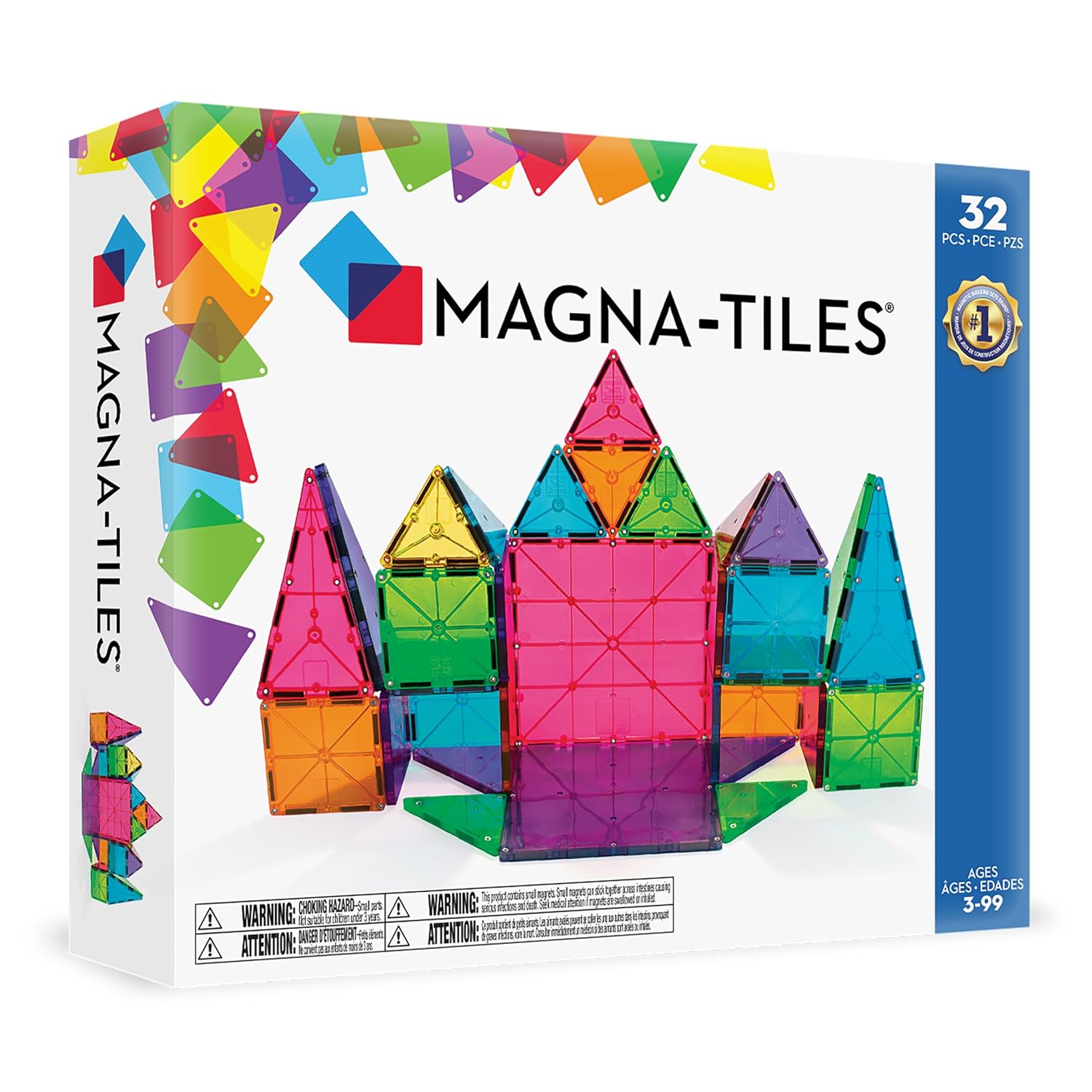
| MAGNA-TILES Classic 32-Piece Set | Magnetic geometric shapes: 16 squares and 16 triangles | Package labelled ages 3–99; small-parts and small-magnet warnings remain important |
| MEGA BLOKS First Builders Big Building Bag, Blue | Stacking-block approach with a storage bag | Pictured DCH63 package says 1+ and 80 blocks, but the listing’s description says 60; confirm the exact version and warnings before choosing |
Age labels are a first check, not a way to rank these sets by how clever, advanced or ready a child is. Do not substitute a broad “early builder” description for the instructions and warnings on the exact package.
Our pick: KID K’NEX Budding Builders for a guided starting point
The 85618 tub gives the comparison a particularly clear project-based option: 100 parts and an instruction sheet with 50 building ideas. The pictured package and the manufacturer’s instructions index identify the same model. Its rods and connectors offer a different building method from stacking blocks or arranging flat magnetic tiles.
Choose it when suggested models are useful to the activity you want to share. A caregiver can choose an idea, identify the required pieces and help keep the remaining parts together. The tub supplies a storage container; it does not establish that every household can leave the parts accessible between sessions.
The boundary is just as clear as the recommendation. Although the maker describes large parts, the package carries a small-parts choking warning and excludes children under three. No exact minimum component measurements are established here. Do not read “large parts” as “every component is large,” or use it to dismiss the warning. Connector force, comfort and independent assembly ability can differ between children; this is not a hands-on assessment of those qualities.
Alternative for geometric building: MAGNA-TILES Classic 32
Classic 32 changes the activity to magnetic shapes. Its specified inventory is two large and fourteen small squares, plus eight equilateral, four right and four isosceles triangles. That gives a caregiver an exact shape list to compare with the planned activity rather than relying on a large headline piece count.
Choose this alternative when arranging and combining geometric shapes is the intended activity. It is not a rod-and-connector substitute, and the shape inventory does not prove what a child will learn. The package shows an age range beginning at three and includes warnings about small parts and small magnets. Follow the exact package guidance; neither the age label nor a claim about the tile construction cancels those warnings.
The maker page also lists set dimensions. Those figures do not establish the smallest tile or component size, so they are not used here to judge grip or suitability. Confirm any required physical measurements for the actual set before relying on them.
MEGA BLOKS Blue bag: resolve the version before choosing
The First Builders Blue bag is the stacking-block option in this comparison, but its current listing evidence is inconsistent. The description says 60 blocks. The pictured bag is marked DCH63, 80 blocks and 1+. Mattel’s DCH63 support page likewise describes an 80-block set for ages one and up.
That does not settle which contents the exact offer will deliver. A separate maker page for a newer JGK05 bag also describes 80 pieces; a similar name or count is not evidence that JGK05 and DCH63 are the same version. Confirm the model, contents, age label and warnings for the package being offered. This version uncertainty keeps the Blue bag from being the recommendation here; it does not require rejecting the independently identified alternatives.
A practical check before opening the set
- Read the exact package’s age label, warnings and instructions before deciding whether the activity fits the child and setting.
- Compare the connection method with the activity: suggested rod-and-connector projects, geometric magnetic construction, or stacking blocks.
- Check the actual contents and smallest components. A package dimension or a “big pieces” phrase is not a component measurement.
- Plan where loose pieces will be used, counted and stored. A supplied bag or tub is a container, not a child-resistant storage claim.
- Treat learning, developmental, quality and safety marketing as claims, not demonstrated outcomes from this comparison.
A useful first set has a clear identity and an activity you can explain. KID K’NEX 85618 is the guided-project pick here within its 3+ and small-parts limits; Classic 32 is the geometric alternative. Keep the Blue bag’s version question open until the exact contents are confirmed.